Join the Hirello.ai Newsletter
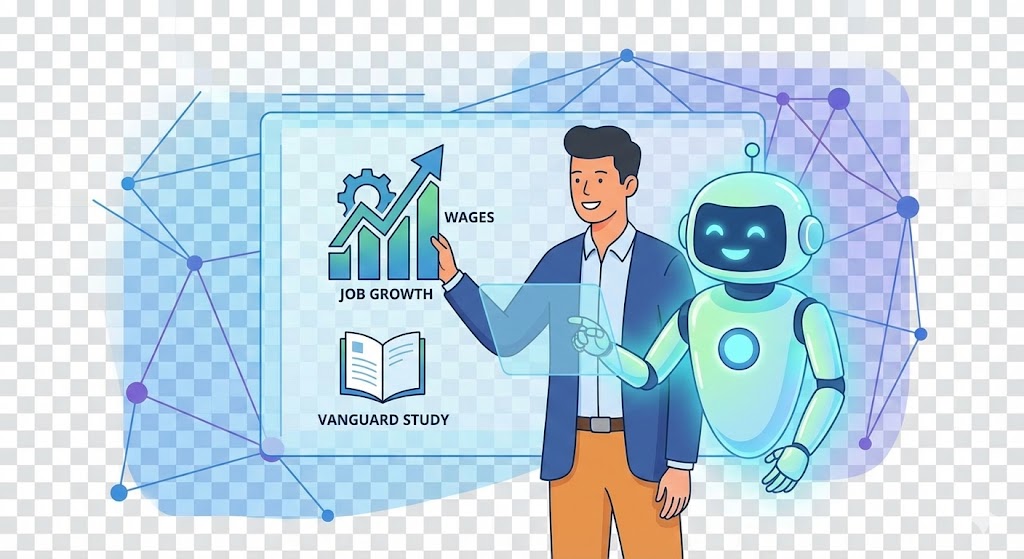
Vanguard Job Study
Surprising Data: Vanguard Study Reveals AI-Exposed Jobs Are Actually Growing 2x Faster
The Fear vs. The Reality. For the last two years, the biggest headline in the career world has been fear: "Will AI take my job?" It is a valid concern. With tools like ChatGPT and Claude automating writing, coding, and analysis, many assumed that white-collar roles would be the first to vanish.
However, a massive new study from investment giant Vanguard has turned that assumption on its head. Instead of destroying jobs, AI appears to be fueling them.
The "2x Growth" Statistic According to Vanguard’s latest research, occupations with "high exposure" to AI (meaning jobs that use AI heavily) are not shrinking. They are actually growing twice as fast as the rest of the job market.
Vanguard analyzed employment data from mid-2023 to mid-2025 and found two shocking trends:
AI-Exposed Jobs are Booming: Employment in these roles (like data scientists, HR assistants, and law clerks) grew by 1.7%, outpacing the growth seen before the pandemic.
Non-AI Jobs are Slowing: Meanwhile, jobs with low AI exposure saw their growth rate slow down to just 0.8%.
It’s Not Just Jobs—It’s Pay, Too The study didn't just look at hiring; it looked at wallets. If AI was making human workers less valuable, you would expect wages to drop. The data shows the exact opposite.
Vanguard found that real wage growth for AI-exposed jobs accelerated to 3.8% in the post-COVID era. Compare that to the pre-COVID era, where wage growth for these same roles was a tiny 0.1%.
Why is this happening? The researchers argue that we are currently in the "augmentation" phase, not the "replacement" phase.
AI is acting as a "copilot," removing the boring, repetitive parts of a job (like data entry or basic drafting) and freeing up humans to do higher-value work. Because these employees are now more productive, companies can afford to pay them more and hire more of them to scale their operations.
What This Means for You If you are worried about your career, the data suggests you shouldn't run away from AI—you should run toward it. The jobs that are growing are the ones that embrace these tools.
Don't hide from tech: Learn how to use AI tools relevant to your industry.
Focus on "Human" skills: Strategy, complex decision-making, and emotional intelligence are the "high-value" tasks AI can't touch yet.
The verdict from Vanguard is clear: The robots aren't coming for your job—they're coming to give you a raise, but only if you learn to work with them.
